
Hiring in Croatia : Need to Know Before Hiring in Croatia For Employers

Before hiring employees in Croatia, there are a few important things you’ll need to know. Firstly, it’s a legal obligation in Croatia to include details of any sick or vacation leave on a payslip. It’s important for employers to know that all time off must be recorded and approved. As an employer in Croatia, there are also various tax free allowances available to be paid entirely at the employer’s discretion. Employers should know what these are and how much is typically paid out for each. Good To Know Under Croatian law, an Employer of Record is able to engage in an indefinite employment contract but the assignment of the person to your company must be limited to a period of no more than three years. After three years of continuous working, the employee must take a break of at least two months before he can be registered to work for you again. Employees must be registered for mandatory health insurance with the Croatian Health Insurance Fund (HZZO). This entitles them to sick pay or income replacement benefit, and sick leave as needed. There are various tax free allowances available to be paid entirely at the employer’s discretion. These include a 5,000 kuna bonus allowance, 3,000 Easter/Christmas Bonus and a 5,000 kuna tax free food allowance. Employment in Croatia Working Hours and Overtime In Croatia, full-time employment cannot be more than 40 hours per week. An employee can work up to 48 hours in a week, but eight of these will be overtime. Employees are entitled to a minimum of 12 hours break between two consecutive work days and at least 24 consecutive hours once a week. It is a legal obligation in Croatia to include details of any leave on a payslip, so all time off must be recorded and approved. Probationary Period A probationary period in Croatia cannot exceed six months. During the agreed probationary period, the termination period must be at least seven days. Notice Period In Croatia, the notice period is defined by law and varies depending on the length of continuous employment, and potentially with age. It goes as follows: Two weeks for more than one year One a half months months for more than two years employment Two months for more than five years employment Two and a half months for more than 10 years employment Three months for more than 20 years employment Non Complete Agreement Non-compete clauses can be included in the employment agreement provided it has been mutually agreed, and the employee is earning above the national average wage in Croatia. A non-compete cannot last more than two years and will only be valid if it aims to protect legitimate business interests and does not disproportionately limit the ex-employee’s work opportunities elsewhere. Employer Tax In Croatia, an employer’s social contributions total 16.5%. Health Insurance is paid at 16.5% of an employee’s gross salary, and is not capped.  Individual Tax Employees in Croatia pay between 24% and 36% in taxes depending on their income bracket. Employees also pay social security contributions of 20%. These are pension contributions (15% goes to Pillar I and 5% goes to Pillar II) Both contributions are capped at 52,452 HRK monthly. In Croatia, employees also pay a municipality surtax of up to 18%. Termination of Employment All terminations must be notified to the employee in writing and there can be regular or exceptional terminations. The types of terminations are as follows: Regular termination (with agreed notice) Notice for business reasons: This can include redundancy of an employee’s role due to economic, technical, or organisational reasons. The employer must first check that they cannot engage the employee in another role and is not allowed to hire someone in the same role for at least six months. Notice for personal reasons: This means the employee is unable to fulfil their contractual duties due to a permanent characteristic or capabilities. Again, the employer must check that they can’t engage the employee in another suitable role first Notice for employee’s misconduct: This refers to breach of contract. The employee should get a written warning with the possibility of termination in case of continuing breach of contract—unless circumstances mean it is reasonable not to give this warning.  Notice due to failing probationary period: This type of termination means that an employee does not perform to expectation during the probationary period.  Exceptional terminations can be executed with only 15 days’ notice from learning about an issue where there is a serious breach in employment relationship or other highly important fact. Start Hiring Employees in Croatia Setting up a business entity everywhere you want to hire a new employee isn’t scalable—it takes too long and the legal fees are high. At the same time, understanding and adhering to the local labor laws and employee expectations can be complex and time consuming. And it’s hard to find reliable information on up-to-date employment information for all the countries where you’re considering hiring. Not to mention tracking down invoices and managing employee contracts over email and spreadsheets—that gets messy fast. We can’t afford to take risks when it comes to compliance—we need to make sure we follow the local guidelines, especially when it comes to taxes and legalities. With ISHC, you can manage HR and recruiting in one platform!

Easier to Seasonal Work in Serbia

On 3 September 2021, the Ministry of Labour, Employment, Veteran and Social Policy of the Republic of Serbia published on its official website the Draft Law on Employment due to the increased volume of work in certain activities The constitutional basis for the adoption of this Draft is contained in Article 97, item 8 of the Constitution of the Republic of Serbia, which stipulates that the Republic of Serbia, among other things, regulates the system in the field of labour relations. Bearing in mind that the reform of seasonal employment in agriculture has been successfully implemented by the Law on Simplified Employment in Seasonal Jobs in Certain Activities (“Official Gazette of RS” No. 50/18), this Draft seeks to achieve the same results in other sectors, such as: construction; services, accommodation and food; administrative and support service activities as well employment of natural persons in childcare, care for the elderly, as well as cleaning of residential buildings. Employed person is defined as any adult natural person who is employed by the employer in accordance with this Draft. A person under the age of 18 may be employed under the conditions prescribed for the employment of persons under the age of 18 by the law governing work and the decree determining dangerous work for children. Employment of persons under the age of 18 in accordance with this Draft in the Construction Sector is prohibited. It also enables domestic employers to hire foreign citizens who do not need a visa to enter the Republic of Serbia in accordance with the visa regime, without the obligation to obtain a work permit for foreigners in accordance with the law governing the work of foreigners, while they reside in the Republic of Serbia for a short period of time in accordance with the regulations governing the stay of foreigners. According to this Draft, a person engaged in employment is not considered to be a person who occasionally and without compensation assists the employer in performing work (relatives, neighbours, friends). Rights of employed persons The employed person has the following rights: The right to limited working hours; The right to rest during daily work, daily and weekly rest; The right to compensation for their work; Prohibition of restrictions on work with another employer and prohibition of discrimination against the engaged person; The right to pension and disability insurance, as well as compulsory health insurance; The right to legal protection before the Agency for Peaceful Dispute Resolution of the Republic of Serbia. Conditions that the employer must fulfil For the purposes of this Draft, an employer is considered to be an entrepreneur, legal entity or natural person who directly and for his own needs hires a person for jobs and under the conditions provided for in this Draft. Bearing in mind that work in the sense of the Draft is considered to be work outside the employment relationship, the employer has the obligation to submit a written notice to the person who plans to hire about the conditions of employment The employer has the obligation to inform the employed person in writing about the working conditions, before he / she starts working. The obligation is considered fulfilled when a notice of working conditions is submitted to the employed person on his profile, which is accessed through the Information System for registration and deregistration of employed persons, which contains information on: the employer and the employee; conditions of employment; rights regarding working hours and holidays. The employer is obliged to pay personal income tax and contributions for obligatory social insurance on the basis of the compensation for work received by the employed person. Tax is calculated at the rate of 10%, and contributions are calculated and paid at the rate of 25% for mandatory pension and disability insurance, and for health insurance in case of injuries at work and occupational diseases 2%. The purpose of the Draft The Draft aims to solve the problem of informally and occasionally engaged workers in the field of agriculture, construction, tourism and catering, and household and auxiliary jobs. The aim of the Draft is to set the legal framework for jobs that are of limited duration (several days a month), by simplifying the method of registration of workers, as well as the calculation and payment of taxes and contributions.

Bangladeshi Workers Hiring : Reasons of Hiring Bangladeshi Workers in 2025

Bangladesh has been addressed as a Economic Tiger of South Asia. And it’s skilled workforce is the reason behind. Bangladesh’s economy is booming since past few years if you look closely. The thrusting power for economical growth has been generating from a long before when it’s economy was rising with agriculture, garments and foreign remittance mostly. Agricultural trade is the oldest form of it’s economical growth but the garments and foreign remittance are the modern tools of growing economy. Dear Reader, it will amaze you if you just vist a cloting store nearby or even the tag of your branded shirt might have written ‘Made in Bangladesh’ on it! Yes, Bangladesh has become one of the leading supplier of garments worldwide. And the success story of garments business in Bangladesh are quite similar to other successful businesses! Lower production cost with on time shipment than the other competitors. Do you know why the production cost is lower in Bangladesh? Because the labour comes cheap here! The manpower is vast in this sector. I have seen 24,000 females are working 24 hours in three shifts. People are hardworking here they are willing to work to make a better living just like others. But the dedication of those workers that makes the difference. They are keen to do any hard work and make a better living. That is the point, where most of the European has lost their interests in jobs like construction workers, cleaners, waiters etc there you can hire Bangladeshi workers in a lower salary. It will reduce your cost for running the company and make more profit. That is why most of the EU government has announced foreign workers quota for covering the labour shortage problem. If you closely look at Qatar, they had employed almost 25,00,0000 workers from South Asia for preparing FIFA World Cup 2022 stadiums and the majority of the workers were from Bangladesh. At the first phase of my article I mentioned the economical growth of Bangladesh and this where they are making progress by utilising manpower export and their remittance. Bangladeshi people are now very much inclined to work abroad to make a better living their interest can be a game changing for the growing companies if they properly utilize their interest to the work, the visible growth of their business can be seen from everywhere.

FAQ Hiring International Employees: Key Benefits of Working With International Workers

With ISHC, you are assured of easy tapping into a pool of global talent, and accessing the best candidates for the job in a safe and secured manner. We provide you with sufficient risk mitigation, engaging and retaining your international workforce with 100% compliance with all legal and financial obligations. With us, onboarding of your new employees will be carefully and properly carried out within a short time. What do Companies need to know about Hiring Internationally? There are several things businesses around the world must know about employing globally. International hiring brings about workplace diversification, improved productivity, and performance, quick growth, creativity, and innovation, etc. However, companies also need to know that this process must be carefully carried out without mistakes but with proper adherence to regulations. What are the Challenges Associated with International Hiring? Various problems are associated with overseas hiring, among them are inadequate compliance, processing of employment and travel documents, onboarding, differences in policies and regulations, man management, etc. What is Offshoring? Offshoring is the practice of hiring companies or employees in other countries. It also refers to the process of outsourcing jobs to talents from other countries. Offshoring is usually carried out by companies in industrialized countries to seek talents with lower costs in developing nations. Who is considered a foreign national? A foreign national is an individual who is not a citizen (which refers to their legal status) or national (which refers to their place of birth) of a specific country. In terms of employment in the United States, a foreign national (also known as a foreign employee or foreign worker) is an employee or independent contractor who works in the United States but is not a naturalized U.S. citizen How many foreign workers a company can hire? There is no set maximum for how many foreign workers an organization can hire; however, that doesn’t mean you won’t face any limitations. Business owners seeking to hire foreign nationals will need to pay close attention to current immigration processes. Can you hire someone without a work visa? Sort of. Yes, you can technically hire a foreign national who doesn’t have a work visa. However, they can’t start working for you until they have one. If the foreign worker does not have a work visa at the time of hire, you will have to sponsor them or help them get a work visa before their official start date. What kind of jobs qualifies hiring foreign workers? Numerous temporary and permanent jobs qualify for foreign labor certification. These can include jobs such as specialty professional specialty work (e.g., architects, engineers, therapists and healthcare workers), temporary or seasonal agricultural labor (e.g., farm workers), and temporary or seasonal nonagricultural labor (e.g., housekeepers and cooks). How to hire foreign workers? 1. Acquire certifications. You need to acquire certifications and permission to recruit foreign workforce as per your countries law and regulations. You need to proof that with your countries workforce you can’t full fill your company’s requirements, to produce more your company needs foreign workforce. The you can be able to meet the requirements of acquiring foreign workers 2. Recruit and interview foreign workers. The hiring process for foreign workers will look a little different from the typical hiring process you use for your country’s citizens. Keep this in mind as you post on job boards, review resumes, and conduct job candidate interviews. The overall process can also take much longer. The candidate will need to be approved for their visa before you can officially hire them, and this paperwork could take a while. 3. Acquire Workforce. Your foreign national employee will need a work visa from Immigration Services before they can legally work in the country you want to bring them in. If they already have one, you can verify their work authorization with Immigration Services. If they don’t, you may have to sponsor their work visa, which will take a lot more time and effort on your part. 4. Comply with Tax Laws. Tax laws varies country to country but the basic laws are same for almost everywhere. You can find it out with the taxation authorities in your country. Hiring a foreign national employee can greatly benefit your business as well as the life of the employee. Every business should strive for a diverse workplace, and hiring a foreign employee is one way to get there.

How To Recruit Foreign Workers In Romania?

Since 2007, Romania has been attracting a considerable number of workers from Asia, Europe and other countries nearby. These workers usually come from many different sectors of activity and often work for different Romanian Companies . In this blogpost, I am going to give you some tips in order to help you move forward. In order to catch up with the other European countries, Romanian companies are hiring in practically all sectors. In fact, even though the sectors recruiting the most are agriculture, oil, hydroelectricity, mechanics or metallurgy, they look for foreign workers in Hotel, in pharmaceutical industry, food industry, IT, in civil engineering and last but not least, in the construction industry. For these particular sectors, they need particularly skilled workers, and that is why the Romanian companies always hire international workers. However, that does not mean there is a high percentage of unemployment. Indeed, the current unemployment rate is between 6 and 8 percent, a rate completely acceptable for a country still in development. On 27th January, 2022 Romania Government has declared the quota of 100000 non EU workers in Romania. It has opened a potential gateway to success for the Entrepreneurs and others who could not able to maximize their potential of growth for shortage of workforc Companies employing staff from countries outside the European Union (especially from Asian countries), are required to go through a legal process consisting of several stages, the first one being the approval from the Romanian Immigration Office. If the quota set by the Government for the current year is exceeded, employers will no longer be able to hire staff from non-EU countries. This is why it is recommended to plan ahead and to draw a strategy that will allow employers to fill vacancies. As for the legal formalities, it is better to start the process as soon as possible. In order to receive a favorable answer from the Romanian Immigration Office, the employer must meet certain criteria, such as: to prove that the foreigner meets the conditions of professional training and work experience provided by the legislation in force for that specific job, to prove that the company has not been sanctioned in the past for illegal employment, to have paid up to date all financial obligations to the state budget and many more. The approval from the immigration office is issued within 30 days of registration of the application, except for situations where extended checks are required. Once the employer is authorized to hire the respective foreign worker, the latter will have to obtain the long-term work visa granted by the Romanian Embassy or Consulate. In Conclusion, Romanian companies in need of filling up a high number of job vacancies. Among the foreigners who show the most interest in accessing the Romanian labor market are the Asian workers, motivated by higher salaries and better working conditions, compared to those in their country of origin.

Romanian Government Approves 100,000 Working Permits for Foreign Workers in 2022

Romania approves 100,000 working permits for foreign workers in 2022. It is the highest number of working permits ever approved by the Government for foreigners outside the European Union. In 2021 there was a limit of 25,000 working permits, which was later modified to 50,000 permits following the request of both companies and the recruiting agencies. The workforce deficit in Romania is at its peak. According to official sources, around 250,000 vacancies were registered in Romania last year. Unofficial sources talk about 1 million workers needed in the country. The law says a job can be offered to somebody from outside the EU if the employer proves it did diligence to occupy the position with workers from Romania, EU member states or the European Economic Space. Many jobs are in agricultural, construction or hospitality, sectors that are not attractive anymore to the Europeans. Thousands of companies in Romania have already applied for a license, and the 100,000-limit could prove to be unsatisfactory once again. Either way, this is the first time the Romanian Government seems to have understood the actual work deficit in the country. On the other hand, the Romanians working abroad remitted more money than the direct foreign investors in 2020. If only 10% of these workers returned to Romania, this workforce deficit would be covered. Romania is one of the preferred destinations for the Asian workforce. The data show that Turkey, Nepal, and Bangladesh are the top countries regarding the foreign workers present in Romania. Also, China and Vietnam are among the other Asian countries whose workers come to Romania to find a job.

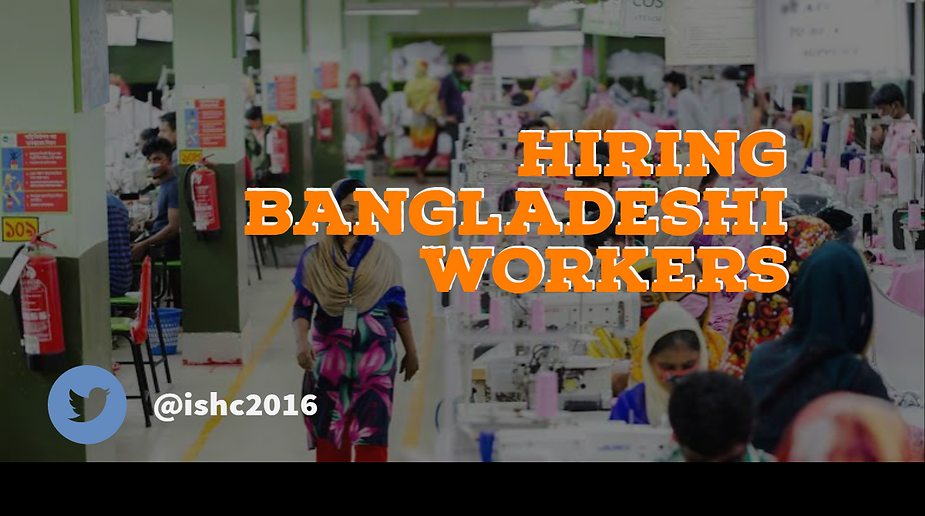
Hiring Bangladeshi Workers: Reasons of Hiring Bangladeshi Workers

Bangladesh has been addressed as a Economic Tiger of South Asia. And it’s skilled workforce is the reason behind. Bangladesh’s economy is booming since past few years if you look closely. The thrusting power for economical growth has been generating from a long before when it’s economy was rising with agriculture, garments and foreign remittance mostly. Agricultural trade is the oldest form of it’s economical growth but the garments and foreign remittance are the modern tools of growing economy. Dear Reader, it will amaze you if you just vist a cloting store nearby or even the tag of your branded shirt might have written ‘Made in Bangladesh’ on it! Yes, Bangladesh has become one of the leading supplier of garments worldwide. And the success story of garments business in Bangladesh are quite similar to other successful businesses! Lower production cost with on time shipment than the other competitors. Do you know why the production cost is lower in Bangladesh? Because the labour comes cheap here! The manpower is vast in this sector. I have seen 24,000 females are working 24 hours in three shifts. People are hardworking here they are willing to work to make a better living just like others. But the dedication of those workers that makes the difference. They are keen to do any hard work and make a better living. That is the point, where most of the European has lost their interests in jobs like construction workers, cleaners, waiters etc there you can hire Bangladeshi workers in a lower salary. It will reduce your cost for running the company and make more profit. That is why most of the EU government has announced foreign workers quota for covering the labour shortage problem. If you closely look at Qatar, they had employed almost 25,00,0000 workers from South Asia for preparing FIFA World Cup 2022 stadiums and the majority of the workers were from Bangladesh. At the first phase of my article I mentioned the economical growth of Bangladesh and this where they are making progress by utilising manpower export and their remittance. Bangladeshi people are now very much inclined to work abroad to make a better living their interest can be a game changing for the growing companies if they properly utilize their interest to the work, the visible growth of their business can be seen from everywhere.

The Importance of Strategic Workforce Planning in the Construction Industry

The construction industry is known for its dynamic nature and fluctuating labor demands. In order to stay competitive and meet project deadlines, construction companies must prioritize strategic workforce planning. This article explores the importance of strategic workforce planning in the construction industry and provides valuable insights for employers looking to optimize their workforce. Construction projects often require a diverse skill set, ranging from architects and engineers to carpenters and laborers. By strategically planning their workforce, construction companies can ensure they have the right talent at the right time, avoiding costly delays and inefficiencies. This article delves into the key steps and considerations involved in effective strategic workforce planning, including forecasting labor needs, talent acquisition strategies, and workforce development initiatives. With the help of International Strategic Hiring Choices (ISHC), construction companies can access a wide pool of skilled workers and streamline their workforce planning efforts. ISHC’s recruitment expertise and industry knowledge enable employers to navigate the complex labor market, identify top talent, and ensure a smooth execution of construction projects. By leveraging ISHC’s comprehensive services, construction businesses can optimize their workforce and drive project success. To read the full article on the importance of strategic workforce planning in the construction industry, visit www.int-shc.org.

The Staffing Strategist Your Guide to Talent Acquisition

Welcome to our blog, where we share valuable insights, tips, and industry news to empower both clients and candidates in the world of staffing and recruitment we believe that knowledge is power, and our blog serves as a platform to provide Whether you’re a hiring manager seeking strategies to streamline your recruitment process or a job seeker looking for career advice and interview tips, our blog has something for everyone. Stay tuned for regular updates and expert insights Recruit ology Tips & Trends for Hiring Success Whether you’re a hiring manager seeking strategies to streamline your recruitment process or a job seeker looking for career advice and interview tips, our blog has something for everyone. Stay tuned for regular updates and expert insights Looking for top talent for permanent roles Concerned about cultural fit when hiring Require specialized skills for short-term projects Seeking executive-level talent to drive your organization’s success Our blog is your go-to resource for the latest trends, best practices, and expert advice in the staffing industry. From articles on optimizing your hiring process and navigating employment law changes to career development Recruit ology Tips & Trends for Hiring Success We’re committed to not providing exceptional staffing solutions but also empowering our clients & candidates Staffing solution is right for you Skills for short-term projects Need to fill a position quickly

Verified by ExactMetrics